Plan and Cutaway Drawing Church of San Vitale
| St. Peter's Basilica | |
|---|---|
| Basilica Sancti Petri (Latin) | |
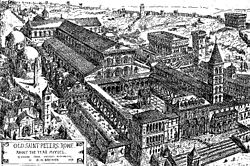 19th-century drawing of St. Peter's Basilica equally it is thought to have looked effectually 1450. The Vatican Obelisk is on the left, however standing on the spot where it was erected on the orders of the Emperor Caligula in 37 Advertising | |
 | |
| 41°54′8″N 12°27′12″E / 41.90222°North 12.45333°E / 41.90222; 12.45333 Coordinates: 41°54′8″N 12°27′12″East / 41.90222°N 12.45333°E / 41.90222; 12.45333 | |
| Location | Rome |
| Country | Papal States |
| Denomination | Catholic Church |
| History | |
| Status | Major basilica |
| Consecrated | c. 360[ citation needed ] |
| Architecture | |
| Style | Early on Christian |
| Groundbreaking | Between 326 (326) and 333 |
| Completed | c. 360 |
| Demolished | c. 1505 |
| Assistants | |
| Diocese | Diocese of Rome |
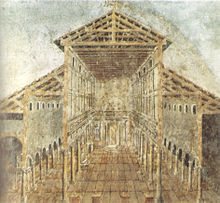
Fresco showing cutaway view of Constantine'due south St. Peter's Basilica as it looked in the 4th century
Old St. Peter'due south Basilica was the building that stood, from the fourth to 16th centuries, where the new St. Peter's Basilica stands today in Vatican city. Construction of the basilica, congenital over the historical site of the Circus of Nero, began during the reign of Emperor Constantine I. The proper noun "one-time St. Peter's Basilica" has been used since the construction of the electric current basilica to distinguish the two buildings.[1]

An early interpretation of the relative locations of the Circus of Nero, and the old and current Basilicas of St. Peter
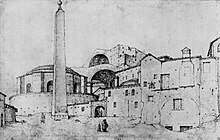
Maarten van Heemskerck - Santa Maria della Febbre, Vatican Obelisk, Saint Peter's Basilica in structure (1532)

A map, circa 1590, by Tiberio Alfarano of the interior of Old Saint Peter's, noting the locations of the original chapels and tombs[two]

Map and location of the Necropolis in relation to (New) St. Peter's

Fontana della Pigna (1st century Advertizing) which stood in the courtyard of the Old St. Peter's Basilica during the Eye Ages and then moved once again, in 1608, to a vast niche in the wall of the Vatican facing the Cortile della Pigna, located in The holy see, in Rome, Italia.
History [edit]
Structure began past orders of the Roman Emperor Constantine I betwixt 318 and 322,[iii] and took about forty years to complete. Over the adjacent twelve centuries, the church gradually gained importance, eventually becoming a major place of pilgrimage in Rome.
Papal coronations were held at the basilica, and in 800, Charlemagne was crowned emperor of the Holy Roman Empire there. In 846, Saracens sacked and damaged the basilica.[four] The raiders seem to have known about Rome's extraordinary treasures. Some holy—and impressive—basilicas, such every bit St. Peter's Basilica, were outside the Aurelian walls, and thus easy targets. They were "filled to overflowing with rich liturgical vessels and with jeweled reliquaries housing all of the relics recently clustered". Every bit a effect, the raiders destroyed Saint Peter's tomb[5] and pillaged the holy shrine.[vi] In response Pope Leo Iv built the Leonine wall and rebuilt the parts of St. Peter's that had been damaged.[seven]
By the 15th century the church was falling into ruin. Discussions on repairing parts of the construction commenced upon the pope'south return from Avignon. 2 people involved in this reconstruction were Leon Battista Alberti and Bernardo Rossellino, who improved the alcove and partially added a multi-story benediction loggia to the atrium facade, on which construction connected intermittently until the new basilica was begun. Alberti pronounced the basilica a structural abomination:
I have noticed in the basilica of St. Peter's in Rome a crass feature: an extremely long and high wall has been constructed over a continuous series of openings, with no curves to give it forcefulness, and no buttresses to lend it support... The whole stretch of wall has been pierced past too many openings and built too loftier... As a effect, the continual strength of the wind has already displaced the wall more than six feet (i.8 m) from the vertical; I accept no uncertainty that eventually some... slight motility volition make information technology collapse...[eight]
At showtime Pope Julius Two had every intention of preserving the old building, but his attending soon turned toward vehement it down and edifice a new structure. Many people of the time were shocked by the proposal, equally the building represented papal continuity going dorsum to Peter. The original chantry was to exist preserved in the new structure that housed it.
Design [edit]

The blueprint was a typical basilica form[9] with the plan and elevation resembling those of Roman basilicas and audience halls, such as the Basilica Ulpia in Trajan's Forum and Constantine'due south own Aula Palatina at Trier, rather than the design of any Greco-Roman temple.[10] The blueprint may have been derived from the description of Solomon's Temple in 1 Kings six.[11]
Constantine took neat pains to build the basilica on the site he and Pope Sylvester I believed to exist Saint Peter's grave, which had been marked since at least the second century.[one] [12] This influenced the layout of the building, which was erected on the sloped Vatican Loma,[12] on the westward banking concern of the Tiber River.[ane] Notably, since the site was outside the boundaries of the ancient city, the apse with the altar was located in the west so that the basilica'due south façade could be approached from Rome itself to the east. The outside, unlike before pagan temples, was not lavishly decorated.[1]
The church was capable of housing from 3,000 to iv,000 worshipers at one fourth dimension. Information technology consisted of five aisles, a broad central nave and two smaller aisles to each side, which were each divided by 21 marble columns, taken from earlier pagan buildings.[thirteen] It was over 350 feet (110 g) long, built in the shape of a Latin cantankerous, and had a gabled roof which was timbered on the interior and which stood at over 100 feet (30 m) at the heart. An atrium, known as the "Garden of Paradise", stood at the entrance and had five doors which led to the body of the church; this was a sixth-century addition.
The chantry of Onetime St. Peter'southward Basilica used several Solomonic columns. According to tradition, Constantine took these columns from the Temple of Solomon and gave them to the church building; however, the columns were probably from an Eastern church. When Gian Lorenzo Bernini built his baldacchino to comprehend the new St. Peter's altar, he drew from the twisted design of the onetime columns. Eight of the original columns were moved to the piers of the new St. Peter's.
Mosaics [edit]

The 1628 full-size copy in oil of the groovy Navicella mosaic by Giotto
The great Navicella mosaic (1305–1313) in the atrium is attributed to Giotto di Bondone. The giant mosaic, deputed by Cardinal Jacopo Stefaneschi, occupied the whole wall above the archway arcade facing the courtyard. It depicted St. Peter walking on the waters. This extraordinary piece of work was mainly destroyed during the construction of the new St. Peter'southward in the 16th century, but fragments were preserved. Navicella ways "little ship" referring to the large boat which dominated the scene, and whose canvass, filled by the storm, loomed over the horizon. Such a natural representation of a seascape was known but from aboriginal works of fine art.
The nave ended with an arch, which held a mosaic of Constantine and Saint Peter, who presented a model of the church to Christ. On the walls, each having 11 windows, were frescoes of various people and scenes from both the Former and New Testament.[14] According to combined statements by Ghiberti and Vasari, Giotto painted five frescoes of the life of Christ and diverse other panels, some of which Vasari said were "either destroyed or carried away from the old structure of St. Peter's during the building of the new walls."[15]
The fragment of an 8th-century mosaic, the Epiphany, is one of the very rare remaining $.25 of the medieval decoration of Erstwhile St. Peter's Basilica. The precious fragment is kept in the sacristy of Santa Maria in Cosmedin. Information technology proves the high artistic quality of the destroyed mosaics. Another i, a continuing madonna, is on a side altar in the Basilica of San Marco in Florence.
-

1673 engraving showing the Navicella mosaic'southward placement on the basilica
-

Navicella mosaic - Fragment in Boville Ernica
-

Navicella mosaic - Fragment in Vatican
-

Mosaic of the Adoration of the Magi, today in Santa Maria in Cosmedin
-

Mater misericordiae, today in San Marco in Florence
-

Mosaic, today in the Museo Barracco
-

2 pairs of the original Solomonic columns at present support curved pediments to form trompe-l'œil porticoes on the piers of St. Peter's.
-

Solomonic Cavalcade
Tombs [edit]
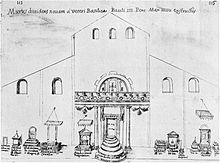
A sketch past Giacomo Grimaldi of the interior of St. Peter'south during its reconstruction, showing the temporary placement of some of the tombs.
Since the crucifixion and burying of Saint Peter in 64 AD, the spot was idea to be the location of the tomb of Saint Peter, where there stood a small shrine. With its increasing prestige, the church building became richly busy with statues, furnishings and elaborate chandeliers, and side tombs and altars were continuously added.[one]
The structure was filled with tombs and bodies of saints and popes. Bones continued to be found in structure as tardily as February 1544.
The bulk of these tombs were destroyed during the sixteenth and seventeenth centuries demolition of Old St. Peter's Basilica (salve ane which was destroyed during the Saracen Sack of the church building in 846). The remainder were translated in office to modern St. Peter'south Basilica, which stands on the site of the original basilica, and a handful of other churches of Rome.
Along with the repeated translations from the aboriginal Catacombs of Rome and two fourteenth century fires in the Archbasilica of Saint John Lateran, the rebuilding of St. Peter's is responsible for the destruction of approximately one-half of all papal tombs. As a upshot, Donato Bramante, the principal builder of modern St. Peter's Basilica, has been remembered as Maestro Ruinante.[16]
Stefaneschi Triptych [edit]

Forepart side. Tempera on wood. cm 178 × 89 (central panel); cm 168 × 83 c. (side panels); cm 45 c. × 83 c. (each section of the predella)

Back side. Tempera on wood. cm 178 × 89 (central panel); cm 168 × 83 c. (side panels); cm 45 c. × 83 c. (each department of the predella)
The Stefaneschi Altarpiece is a triptych by the Italian medieval painter Giotto, commissioned by Cardinal Giacomo Gaetani Stefaneschi[17] to serve as an altarpiece for 1 of the altars of Old St. Peter'south Basilica in Rome.
It is a rare example in Giotto'southward work of a documented commission, and includes Giotto's signature, although the engagement, like most dates for Giotto, is disputed, and many scholars experience the artist's workshop was responsible for its execution.[18] It had long been idea to have been fabricated for the main chantry of the church; more recent inquiry suggests that it was placed on the "canon's altar", located in the nave, only to the left of the huge arched opening into the transept.[xix] It is at present at the Pinacoteca Vaticana, Rome.
See also [edit]
- List of Greco-Roman roofs
- Index of Vatican City-related articles
Notes [edit]
- ^ a b c d eastward Boorsch, Suzanne (Winter 1982–1983). "The Building of the Vatican: The Papacy and Compages". The Metropolitan Museum of Art Bulletin. 40 (three): four–eight.
- ^ Reardon, 2004 .p.274
- ^ Marian Moffett, Michael Fazio, Lawrence Wodehouse, A Globe History of Architecture, 2nd edition 2008, pp. 135
- ^ Davis, Raymond, The Lives of the Ninth-Century Popes (Liber pontificalis), (Liverpool Academy Printing, 1995), 96.
- ^ Partner, Peter (1972). The Lands of St. Peter: The Papal State in the Middle Ages and the Early Renaissance, Volume 10. Academy of California Printing. p. 57. ISBN9780520021815 . Retrieved 6 April 2019.
it was not at this time unusual for Muslims to desecrate Christian Churches for the sake of desecrating them, earthworks has revealed that the tomb of the campaigner was wantonly smashed
- ^ Barbara Kreutz (1996). Earlier the Normans: Southern Italy in the 9th and Tenth Centuries. University of Pennsylvania Printing pp. 25–28.
- ^ Rosemary Guiley, The Encyclopedia of Saints, (InfoBase Publishing, 2001), 208.
- ^ William Tronzo (2005). St. Peter's in the Vatican. Cambridge Academy Press. p. 16. ISBN0-521-64096-2.
- ^ Sobocinski, Melanie Grunow (2005). Detroit and Rome. The Regents of the Univ of Michigan. p. 77. ISBN0-933691-09-2.
- ^ Garder, Helen; et al. (March 17, 2004). Gardner's Fine art Through the Ages With Infotrac. Thomas Wadsworth. p. 219. ISBN0-fifteen-505090-7.
- ^ De la Croix, Horst; Tansey, Richard G.; Kirkpatrick, Diane (1991). Gardner's Art Through the Ages (ninth ed.). Thomson/Wadsworth. p. 260. ISBN0-15-503769-2.
- ^ a b De la Croix, Horst; Tansey, Richard G.; Kirkpatrick, Diane (1991). Gardner'south Art Through the Ages (9th ed.). Thomson/Wadsworth. p. 259. ISBN0-15-503769-2.
- ^ Garder, Helen; et al. (March 17, 2004). Gardner's Art Through the Ages With Infotrac. Thomas Wadsworth. p. 619. ISBN0-15-505090-vii.
- ^ "Old Saint Peter'southward Basilica." Encyclopædia Britannica. 2006.
- ^ Eimerl, Sarel (1967). The Globe of Giotto: c. 1267–1337 . et al. Time-Life Books. p. 102. ISBN0-900658-15-0.
- ^ Patetta, Federico (1943). La figura del Bramante nel "Simia" d'Andrea Guarna (in Italian). Roma: Accademia Nazionale dei Lincei.
- ^ His name is also often constitute as Jacopo Caetani degli Stefaneschi.
- ^ Gardner, 57-eight, gives the documentation from the obituary volume of St. Peter'south. About scholars engagement the altarpiece to c. 1320; Gardner dates information technology to c. 1300; Anne Mueller von den Haegen dates information technology to c. 1313; Kessler dates it to between 1313 and 1320.
- ^ Kempers and De Blaauw, 88-89; Kessler, 91-92.
Further reading [edit]
- The Vatican: spirit and fine art of Christian Rome . New York: The Metropolitan Museum of Art. 1982. ISBN0870993488. (pp. 51–61)
- Weitzmann, Kurt, ed., Historic period of spirituality: late antique and early Christian art, 3rd to seventh century, no. 581, 1979, Metropolitan Museum of Art, New York, ISBN 9780870991790
External links [edit]
- The Constantinian Basilica Article by Jose Ruysschaert
- The Tomb of St Peter, book by Margherita Guarducci
Source: https://en.wikipedia.org/wiki/Old_St._Peter%27s_Basilica
0 Response to "Plan and Cutaway Drawing Church of San Vitale"
Post a Comment